Sail Away
Milan, April 2026 – AMO presents Sail Away, a collaborative exhibition by Greek designer Leda Athanasopoulou and Chinese artist Yumo Yuan: practitioners inside the living traditions of two of the world’s most enduring cultures.
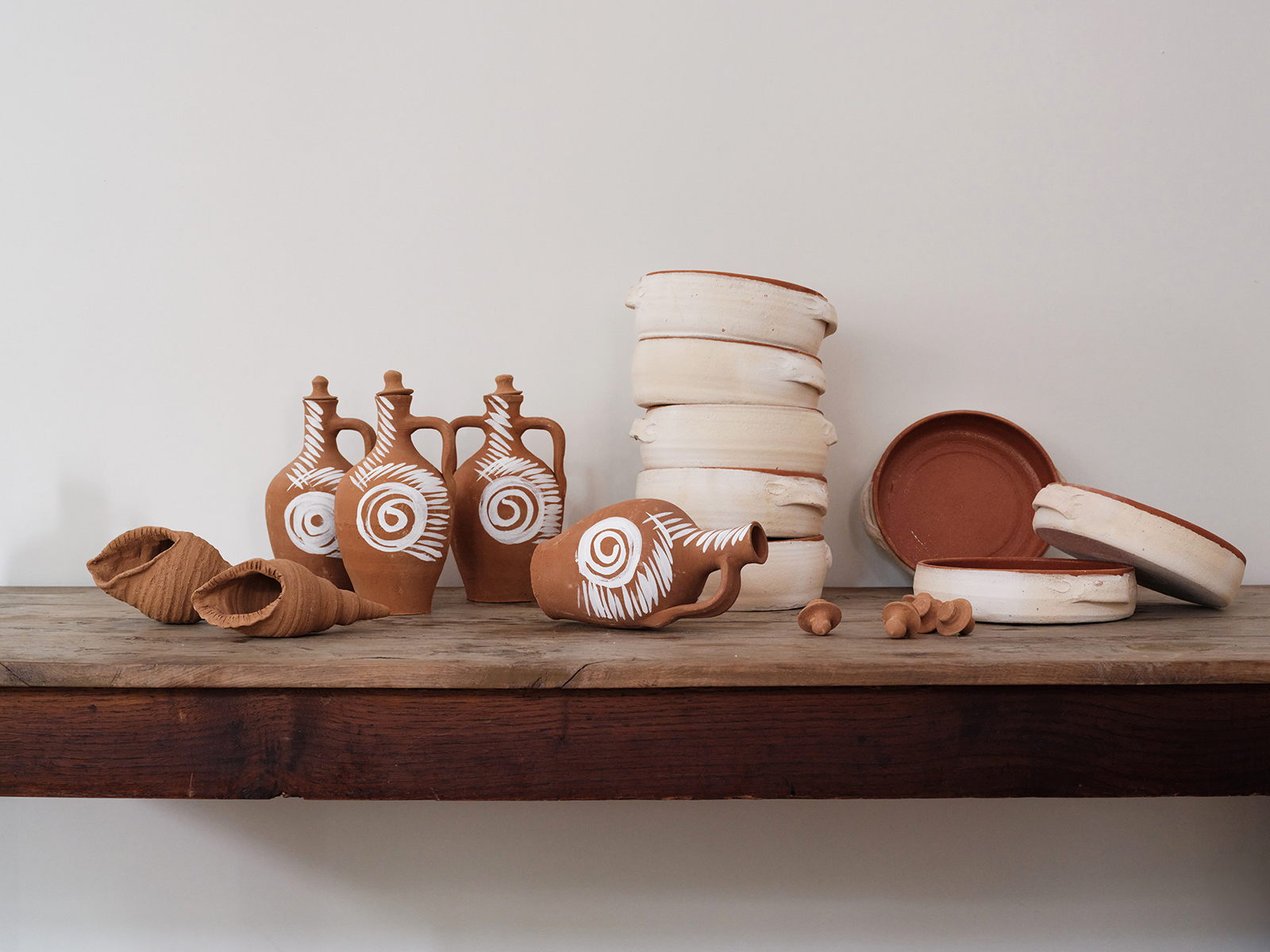
Craft is one of the oldest manifestations of human aspiration. Not merely to produce, but to wish well; to embed hope, care, and meaning into the things we live among. Abundance, continuity, beauty, benevolence: these aspirations generate the same forms independently across civilizations. Three fish sharing a single head, rotating in endless circulation, appear on ancient Egyptian faience, Greek ceramics, and Chinese carvings.
Leda first encountered the folk art traditions of Lesvos through her father, and the craft has stayed with her since. For this project, she curates and commissions pieces from the island, where traditional potters in the village of Mantamados still fire local clay in kilns fueled by olive pits. The exhibition also features aluminum-cast taverna chairs and tama shoes, which are hand-painted by a local artist in the nearby village of Kalloni. Tama, or tamata, are traditional votive offerings left at altars, symbolizing protection and safe passage.

It is these century-spanning traditions that Leda seeks to preserve and renew, working with an array of Greek artisans. Her curation engages with the gradual disappearance of pottery as a slow, process-driven practice, and with the erosion of its utilitarian nature; vessels made for drinking and cooking, now largely displaced from everyday life.
Yumo’s work draws on vintage textile fragments from both his and Leda’s personal archives, treating fabric as a form of storytelling where pattern, structure, and technique carry memory into modern contexts. Through an exchange of research and object studies, Leda has taught Yumo to “speak Greek,” or at least its symbolic vocabulary. A bunch of grapes, a ship under sail, the rooster, a shell – all Greek motifs translated into hand-painted silk weavings inspired by 18th-century warp print techniques. The result is soft, blurred compositions that marry Chinese folk art aesthetics with Hellenic imagery.

Yumo approaches both Greek and Chinese decorative motifs as a kind of shared language; not to translate them precisely, but to understand how similar forms appear across different cultures, and the universal meanings they might carry. In an age of increasing speed and standardization, and the disappearance of ornament from the things that surround us, his work is a way of keeping these symbols alive.
The title refers to one of the show’s central images: the ship. In Greek culture, it evokes the sea as identity, odyssey, and homecoming. In Chinese decorative arts, it means setting sail with a favorable wind, the arrival of good fortune. A symbol that both traditions use to say roughly the same thing: May your journey be smooth, may you arrive safely.